
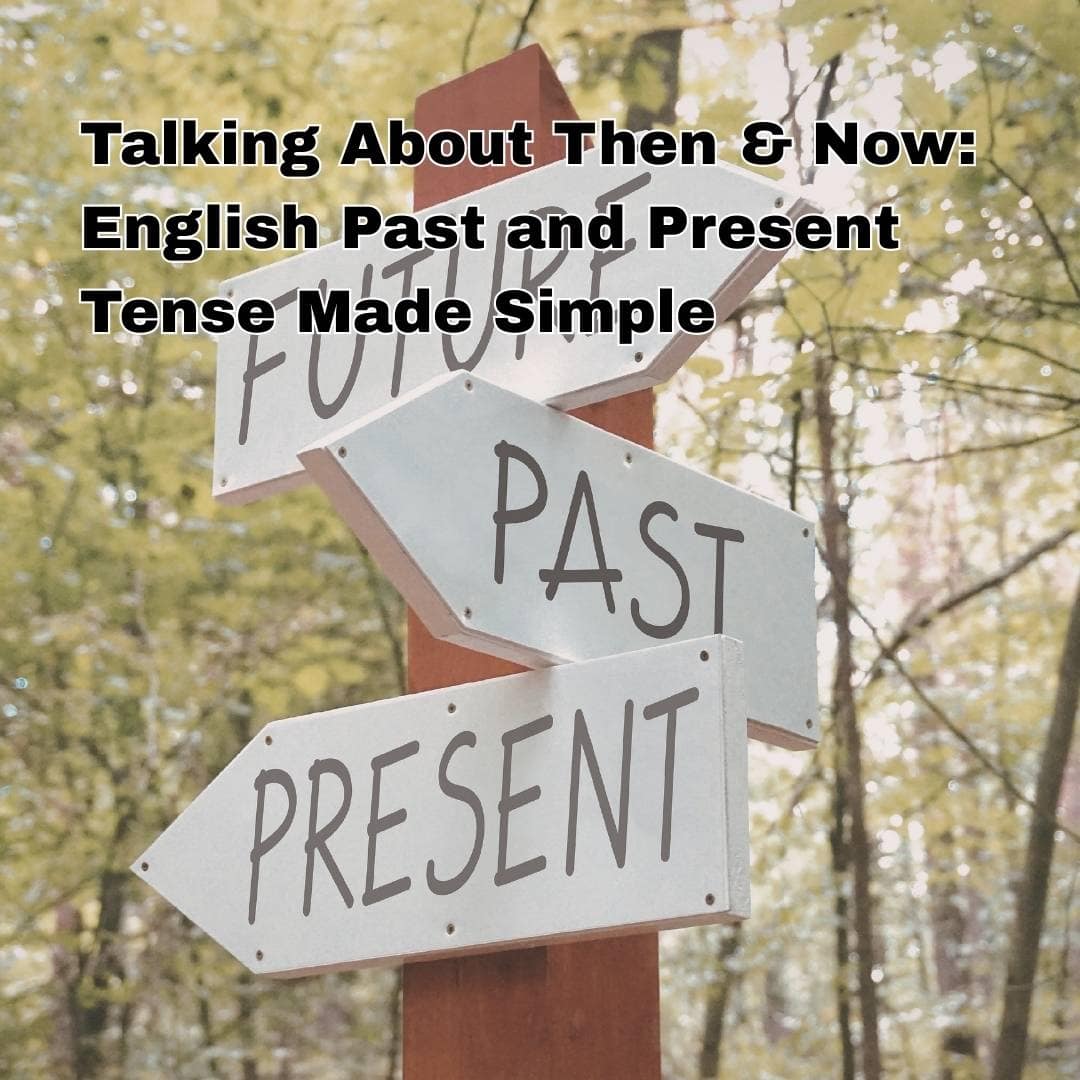
English Through Time: Past and Present Tense Simplified
As an English teacher, I frequently encounter a common challenge among students of all ages and proficiency levels: the confusion between the present tense and the past tense. They often ask questions like, “Why can’t I say this?” or “Is this sentence incorrect?” I completely understand their frustration. English tenses can indeed feel daunting at first.
In this blog post, I will guide you through the English present tense and past tense, clarify how they are used in sentences, and share examples that I often use in explaining its concept. My aim is straightforward: by the end of this article, you should feel more assured in recognizing, forming, and using these tenses naturally in everyday communication.
Why English Tenses Matter
Before diving into the rules and examples, I always remind my students of one crucial concept:
Tense tells time. English tenses enable your listener or reader to grasp when an action takes place—whether it’s occurring now, has occurred before, or happens regularly. If the tense is ambiguous or incorrect, the intended message may become unclear, even if the words are correct.
This is why mastering the present tense and past tense is vital. These two tenses serve as the foundation of everyday English.
What Is the Present Tense?
- The present tense is utilized to discuss:
- Actions occurring now
- Habits and routines
- General truths and facts
- Scheduled events (in some instances)
When explaining, you can use: If it feels current, regular, or always true, you’re likely using the present tense.
Types of Present Tense in English
English has several present tense forms, but we will focus on the most commonly used ones.
- Simple Present Tense
The simple present tense is one of the first tenses I introduce, as it’s practical and frequently used.
When to use it:
- Daily routines
- Habits
- Facts
- Permanent situations
Sentence examples:
- I teach English every day.
- She reads books at night.
- They live near the school.
- Water boils at 100 degrees Celsius.
This tense is ideal for beginners as it builds sentence confidence early on.
- Present Continuous Tense
The present continuous tense describes actions that are happening right now or are temporary.
Structure: Subject + am/is/are + verb-ing
Sentence examples:
- I am explaining English tenses to my students.
- She is studying for her exam.
- They are playing outside.
To remind the students you can say: If you can point to the action while it’s happening, use the present continuous.
Common Present Tense Mistakes I See
As a teacher, I frequently observe these errors:
- Omitting the -s in third-person singular
- Wrong: She walk to school.
- Correct: She walks to school.
- Confusing present simple and present continuous
- Wrong: I am go to work every day.
- Correct: I go to work every day.
Identifying these patterns early helps learners improve much more quickly.
What Is the Past Tense?
The past tense is used to describe actions that have already occurred. An easier explanation / definition of past tense it is the tense of completed time.
If the action is finished and the time frame is over—yesterday, last night, last year—you are using the past tense.
Types of Past Tense in English
- Simple Past Tense
The simple past tense is the most commonly used past tense and the first one that should be mastered.
When to use it:
- Completed actions
- Specific times in the past
Sentence examples:
- I taught my first class ten years ago.
- She finished her homework last night.
- They watched a movie yesterday.
Regular vs. Irregular Verbs
This often confuses learners, especially, those learning English without background or prior knowledge about the language.
Regular verbs: Add -ed to the base form.
- walk → walked
- play → played
- clean → cleaned
Irregular verbs: Change form entirely.
- go → went
- eat → ate
- see → saw
I highly encourage students to practice irregular verbs through sentences, rather than relying solely on memorization. This will help them easily adapt and navigate how to speak naturally rather than sounding robotic.
- Past Continuous Tense
The past continuous tense describes actions that were in progress at a specific time in the past.
Structure: Subject + was/were + verb-ing
Sentence examples:
- I was explaining grammar when the bell rang.
- She was studying while her brother was sleeping.
- They were walking home at sunset.
This tense allows learners to share stories more clearly.
Comparing Present and Past Tense in Sentences
One of the most effective teaching methods I employ is side-by-side comparison.
Example 1:
- I teach English. (present – habit)
- I taught English yesterday. (past – completed)
Example 2:
- She is reading a book. (present – happening now)
- She was reading a book last night. (past – in progress)
Through seeing the contrast in the sentences, the learners adapt and understand its concept better.
Signal Words That Help Identify Tense
You can tell your learners to look for time expressions in the sentences that will help them better identify the tense of the sentence.
Present tense signal words:
- always
- usually
- every day
- now
- currently
Past tense signal words:
- yesterday
- last night
- ago
- in 2020
- earlier
These cues are incredibly beneficial, especially during exams or writing assignments.
How I Teach Tense Usage Effectively
- In my experience, the most effective way to learn tenses is through real sentences, not isolated rules. Additionally, using localized sentences – using their daily activities as examples will help them understand the lesson better.
Here is a list of what you can do, in order to help your students further improve.
- Daily sentence writing
- Speaking practice using routines and past experiences
- Error correction with explanations
- Comparing correct vs. wrong examples
Language retention improves significantly when it is meaningful.
If there’s one thing I want my learners—and you—to remember, it’s this:
You don’t need perfect grammar to communicate, but understanding tenses makes your message clearer.
- The English present tense helps you discuss the present, habits, and facts.
- The English past tense enables you to share experiences, stories, and memories.
By consistently and patiently practicing these tenses in sentences, you will notice genuine improvement. As a teacher, I’ve witnessed it countless times—and I assure you, you can achieve the same.
If you’re learning or teaching English, keep pushing forward. Every correct sentence you construct is progress worth celebrating.
Leave a Reply