
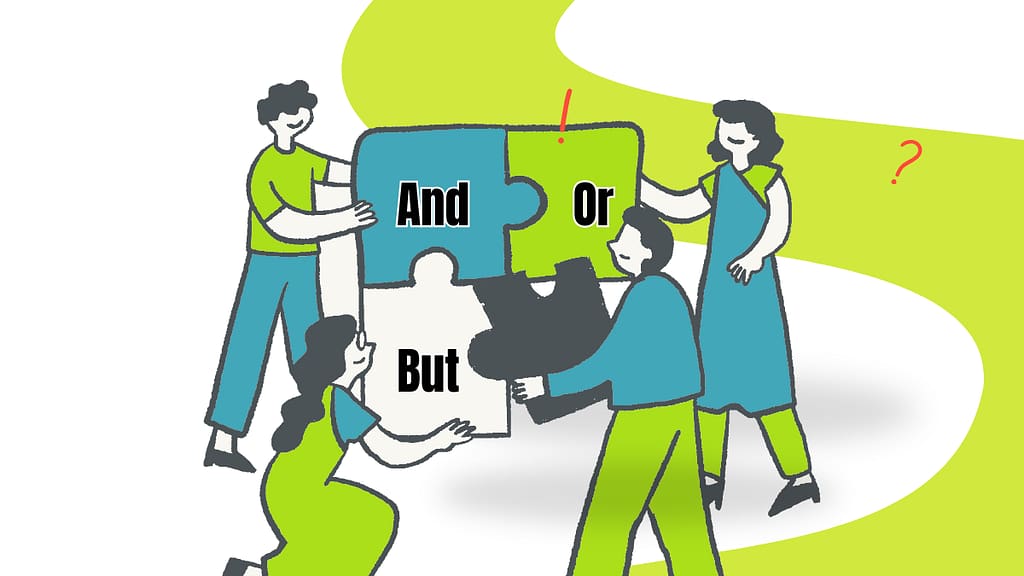
Connecting the Dots: Teaching And, Or, But Overcoming the Confusion
Students are often confident in writing an English sentence, but struggle in deciding which conjunction should be used for the sentence. They are familiar with the words and, or, and but and have encountered them numerous times. However, when it’s time to implement them, confusion surfaces. Sentences become incomplete, hands are raised, or worse, students shy away from longer sentences altogether.
This hesitation reveals something significant: conjunctions may be small words, but they hold substantial meaning. When students don’t fully grasp how conjunctions function, their ideas can feel stuck, unfinished, or unclear. In this post, I aim to share how I teach basic conjunctions—and, or, but to learners who struggle, using the same step-by-step approach I apply in my classroom.
Let’s aim for the learners understanding of the concept of conjunctions rather than have them memorize them.
Realistically speaking, learners don’t struggle with conjunctions because they are difficult, rather, they struggle because it requires decision-making.
the frequent reasons are:
- Students don’t grasp how conjunctions alter meaning.
- They tend to overuse and.
- They confuse or with and.
- They misuse but without recognizing contrast.
- Their first language employs connectors differently.
Once students realize that conjunctions serve as bridges between ideas, rather than mere decorations, everything starts to make sense.
Conjunctions are words that link words, phrases, or sentences together. They facilitate the flow of ideas instead of allowing them to stand alone.
In beginner classrooms, I begin with three core conjunctions:
- and – adds information
- or – indicates a choice
- but – highlights contrast
These three words form the foundation for expanding sentences.
I always introduce “and” first, as it feels the most intuitive for students. “Use and when both ideas are true.” For instance:
- I like apples and bananas.
- She is reading and writing.
- The cat is small and playful.
“Are both ideas happening?”
If the answer is yes, and is typically appropriate.
Common Mistake With And
- Students often overuse and:
“I like milk and I don’t like juice.”
This presents a perfect teaching moment. I refrain from immediate correction and instead ask: “Do these ideas match, or do they contradict?” this question naturally leads to but.
At this stage, structured sentence-building activities with picture cards and movement help students feel the meaning of “adding ideas” before writing.
Now, lets tackle “or” the choice connector, I tell my students “Use or when you must choose.” Examples include:
- Do you want tea or coffee?
- You can sit here or there.
- We can read or draw.
To reinforce this, I physically demonstrate by holding two objects or a picture of the two objects and asking students to pick one. The movement aids understanding.
Common Mistake With Or
- Students sometimes misuse or when they actually mean and:
“I have a pen or a notebook.”
“Do you have one, or do you have both?” this question often clarifies most confusion.
Speaking games and visual decision activities clarify or far better than worksheets alone.
Teaching But: The Contrast Connector
Lastly, we have the contrast connector — but. This conjunction proves to be the most challenging for beginners, so I take my time here. I describe but as: “Something changes.”
Examples include:
- I like ice cream, but it is cold.
- She is tired, but she keeps working.
- He studied a lot, but the test was hard.
Common Mistake With But
- Students sometimes pair but with ideas that don’t contrast:
“I like pizza, but I like pasta.”
A great way to present ‘but” is by telling the learners that the second idea is surprising, hence, I ask them “Is this a surprise?” If it’s not, and is likely the better choice.
Role-playing and picture comparison activities are especially effective for teaching contrast without overwhelming grammar explanations.
Once students grasp each conjunction independently, I position them side by side.
Same sentence idea, different meaning:
- I like cats and dogs. (both)
- I like cats or dogs. (choice)
- I like cats, but not dogs. (contrast)
Observing how the meaning shifts—rather than the structure—helps students appreciate the power of conjunctions.
One reason I emphasize conjunctions early is that they unlock longer sentences.
Without conjunctions: I like apples. I like bananas.
With conjunctions: I like apples and bananas.
This progression feels significant to students. They see immediate improvement, which boosts their confidence.
Interactive sentence-combining tasks allow students to experiment with longer sentences in a safe environment before formal writing.
Common Errors I Hear in Class
Here are frequent mistakes I encounter—and my responses:
- I want juice and water?
→ “Both or one?” - She is tired and she finished her work.
→ “Does the second idea surprise us?” - He likes math but science.
→ “What is missing?”
Instead of correcting directly, I guide students to consider meaning first.
Conjunction practice is most effective when it feels playful:
- Sentence strip mixing and matching
- Acting out sentence meanings
- Picture prompts with oral responses
- Fix-the-sentence challenges
- Group sentence-building games
These activities reinforce understanding without causing anxiety.
Ready-made interactive lesson guides save planning time and ensure students practice conjunctions through movement, visuals, and speaking—not just writing.
Basic conjunctions may appear simple on paper, but they fundamentally shape how students express ideas, choices, and contrasts. When learners genuinely understand and, or, and but, their sentences become clearer, more natural, and more confident.
I consistently remind my students—and myself—that grammar is not about achieving perfection. It’s about facilitating understanding. With patience, clear explanations, and interactive practice, conjunctions transition from confusing little words to powerful tools for communication.
Leave a Reply