
The “Too” Much Paradox: Understanding Why “Very” Isn’t Always Sufficient (and Vice Versa)
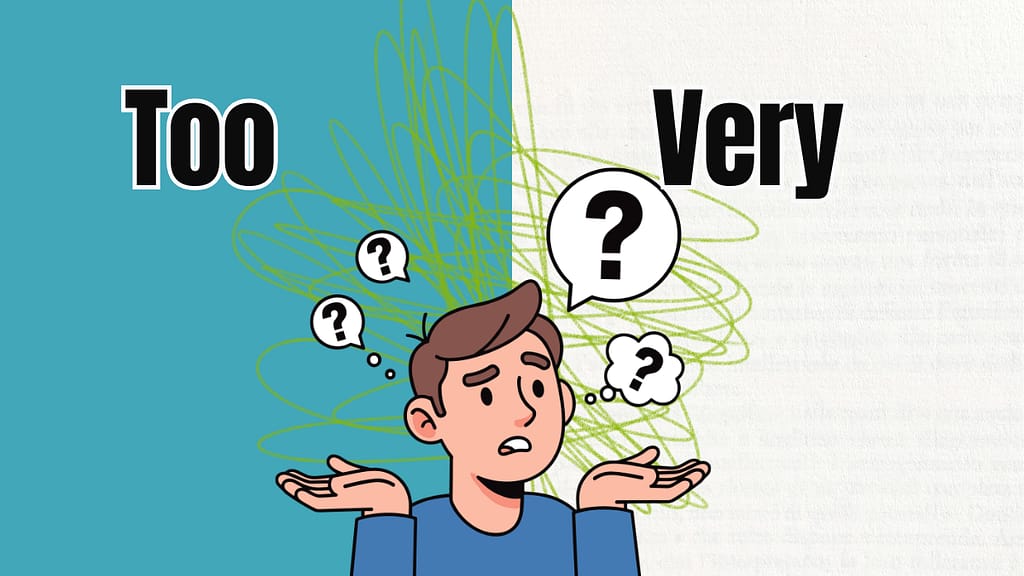
Understanding the distinction between very and too marks one of those subtle “level-up” moments in English. At first glance, both words convey “a high degree,” yet they evoke entirely different feelings. One conveys a compliment, while the other hints at a complaint. If you’ve ever unintentionally upset someone while trying to highlight a positive trait, this guide will clarify the difference.
1. The Intensity Scale: Meet “Very”
Let’s start with the simpler one. I like to think of very as a volume knob. When you use “very,” you are merely amplifying an adjective. It increases the intensity of the word but doesn’t change the situation; it remains neutral or positive.
- “The coffee is very
- hot.” (It’s hot, but drinkable.)
- “She is very
- talented.” (Her talent is significant.)
- “It is a very
- expensive car.” (It costs a lot, but I might buy it if I’m wealthy.)
“Very” simply adds emphasis and serves as a factual statement about degree.
If you want to help your students or children visualize this “volume knob” concept, our interactive lesson guide features an activity from the guide may help elucidate this distinction.
2. The “Problem” Word: Enter “Too”
Now, let’s address the troublemaker. Too doesn’t just mean “a lot.” It signifies more than enough or more than is needed/desirable. This term almost always implies a negative outcome or an obstacle.
If “very” is a volume knob turned up high, “too” is one cranked up to the point of blowing out the speakers.
- “The coffee is too hot.” (I can’t drink it; it will burn my tongue.)
- “She is too talented.” (This is rare, but it may suggest she’s overqualified for a simple role.)
- “The car is too expensive.” (I can’t afford it; my funds are insufficient.)
Using “too” suggests that there’s an issue. This is why saying you are “too happy” to see me implies your heart might burst from the pressure!
To assist learners in grasping the “weight” of the word “too,” We offer a lesson guide that includes several “Scenario Sort” games in this lesson guide filled with interactive activities that challenge students to determine whether a situation is merely intense or genuinely unmanageable.
3. The Grammar of “Too”: The Result Clause
A helpful way to teach the difference is by examining what follows the word. Too often introduces a “to + verb” structure to clarify the problem, whereas very rarely does this.
Compare these:
- Correct: It is too cold to go outside. (The cold is an obstacle.)
- Incorrect: It is very cold to go outside. (This sounds incorrect to a native speaker.)
Very typically stands alone or concludes the thought:
- “It is very cold today.” (A straightforward fact.)
When you use “too,” you establish a cause-and-effect relationship. For instance, “The box is too heavy (cause) to lift (effect).” Teaching this structural cue can significantly improve writing skills.
Several interactive activities that help explain the concept can be found in our interactive lesson guide.
4. Why Learners Get Confused (The Translation Trap)
I’ve noticed that in many languages—such as Spanish (muy), French (très), or Chinese (hěn)—there’s typically one primary word used for emphasis. As a result, learners often default to one term in English.
Students frequently hear “too” in casual or slang contexts and mistakenly assume it’s just a cooler way to say “very.” You might hear someone say, “That’s too cool!” as a compliment. While slang exists, it’s crucial to maintain the distinction in professional and academic English.
Using “too” as a synonym for “very” in a job interview (e.g., “I am too hardworking”) could lead the interviewer to believe you lack work-life balance or might be prone to burnout. Words hold power!
If you’re interested in exploring these words, our lesson guide provides several methods to teach children the concept.
To simplify this for your upcoming conversation or lesson, refer to this breakdown. As highlighted, Very emphasizes the quality, while Too stresses the consequence.
- A Large Suitcase
- Very: “It’s very big.” ( The Vibe: Positive/Neutral. I can fit all my clothes for the trip!)
- Too: “It’s too big.” ( The Vibe: Negative. It won’t fit in the airplane’s overhead bin.)
- A Fast Runner
- Very: “He is very fast.” ( The Vibe: Impressive. He is likely to win the gold medal.)
- Too: “He is too fast.” ( The Vibe: Problematic. I’m trying to film him, but I can’t keep the camera focused.)
- A Spicy Meal
- Very: “It’s very spicy.” (The Vibe: Descriptive. I enjoy the heat, and the flavor is intense.)
- Too: “It’s too spicy.” ( The Vibe: Painful. My mouth is burning, and I have to stop eating.)
- A Quiet Room
- Very: “It’s very quiet in here.” ( The Vibe: Peaceful. It’s an ideal place to study or read a book.)
- Too: “It’s too quiet in here.” ( The Vibe: Eerie. It feels creepy or suspicious, like something is amiss.)
- An Expensive Watch
- Very: “That watch is very expensive.” (The Vibe: High Quality. It represents a luxury item that denotes status.)
- Too: “That watch is too expensive.” (The Vibe: Unattainable. I don’t have sufficient funds to buy it.)
Allowing the learners to navigate the sentences and take charge of fixing these sentences as a “grammar doctor” will help them better absorb the topic.
Mastering Very vs. Too involves transitioning from “translating” to “feeling” the language. Once you recognize that too is a red light (Stop! Problem!) and very is a yellow light (Caution! High intensity!), your English will flow more naturally.
Don’t hesitate to make mistakes—that’s how we learn. Just remember: if you tell your waiter the food is “very good,” they’ll smile. However, if you say it’s “too good,” they might wonder if you’re about to request the recipe or complain about not being able to stop eating!

Leave a Reply