
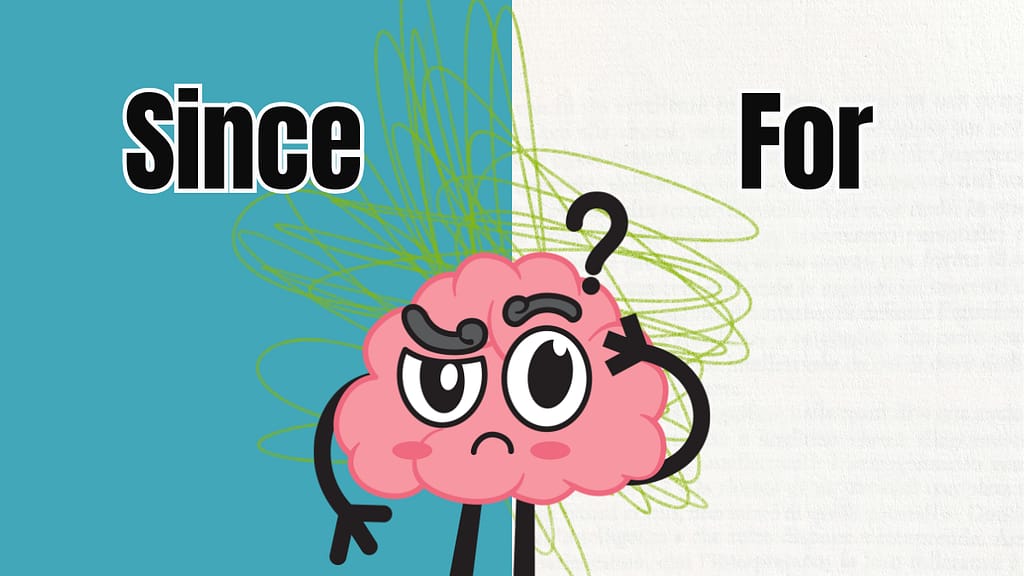
I recall standing in front of a whiteboard that seemed more like a barrier than a helpful tool. I had meticulously sketched a timeline—a neat, horizontal line symbolizing the flow of human existence. At one end, a sharp “X” marked a specific moment in time; at the other, a bracketed segment indicated duration. To me, as a native speaker and educator, the distinction between “since” and “for” was as clear as the difference between reaching a destination and the journey taken. However, gazing at the faces of my intermediate learners, I realized I wasn’t merely teaching grammar; I was attempting to convey a color they couldn’t perceive.
The “Since vs. For” challenge is perhaps the most elusive obstacle in English Language Teaching (ELT). On the surface, it seems like a straightforward binary choice. We instruct our students: “Use for with a period of time, and since with a point in time.” This sounds like a mathematical formula, yet it is precisely where even the most fluent students often falter. The struggle extends beyond linguistics; it is profoundly cognitive. To comprehend why students encounter difficulties here, we must examine three primary pillars of confusion:
First, the interference of the student’s L1 or their native language. Due to the intreference of the first langauge or the language already familiar to the student, they tend to fall into the translation trap. In numerous languages—such as Spanish, French, German, and Mandarin— the distinction we make in English simply does not exist in the same way. In Spanish, for instance, the word desde often encompasses both “since” and “from,” while hace or por might be used for duration. When a student’s mind seeks a direct translation, it encounters a “one-size-fits-all” preposition in their native language. Forcing them to divide that singular concept into two distinct English categories feels akin to asking someone to use two different words for “blue,” depending on whether the sky is clear or overcast.
Another is the present-perfect paradox, we rarely use “since” and “for” in isolation. They are almost always connected to the Present Perfect tense (I have been…). This tense is already a challenge for ESL learners because it exists in a state of “limbo”—it began in the past but remains relevant now. When you add the requirement of selecting a specific time marker, the cognitive load doubles. The student is so occupied with remembering to say “have been” (instead of “am” or “was”) that the choice between “since” and “for” becomes a 50/50 gamble.
Lastly, sometimes it stems from the teachers who creates the “number illusion” wherein teachers inadvertently set a trap by stating, “If you see a number, use for.” However, when the student encounters “I have been here since 2 o’clock” or “Since 1998,” the “number rule” falls apart. To a learner, 2024 is merely a large number, not necessarily a “point” in time. Lacking a deeper conceptual understanding, they rely on superficial cues that often mislead them.
To assist students in differentiating, we must transition from definitions to identities. We need to guide students in identifying the nature of the time they are describing before they select a preposition.
I frequently teach my students the “Snap vs. Stretch” method. The Snap or Since if you can point to this moment on a calendar and “snap” a photo of it? If it’s a specific moment—like a birthday, graduation, or 8:00 AM—it’s a “snap.” You cannot “snap” a photo of “three years”; you can only capture the moment those three years began. On the other hand, for the stretch or For, does the time feel like an elastic band? Can you stretch it? If you are discussing the distance between two points (the “length” of time), you are dealing with a stretch.
By categorizing time as either a Point (Fixed) or a Period (Fluid), students begin to visualize the grammar rather than merely memorize it.
As eductors, we can create this rather confusing lesson to a fun and meaningful learning experience. In order to execute this, we must be equipped with interactive activities that the learners will enjoy and learn at the same time.
The traditional timeline is often too flat and abstract, this is where our first activity enters the picture. I discovered that students respond more positively when they can categorize time into two distinct physical sensations: the “Anchor” and the “Flow.”
The “Anchor” signifies since. It is heavy, stationary, and unchanging. The “Flow,” represented by for, is the water moving past that anchor. It consists of the seconds, minutes, and years that accumulate. By teaching students to ask themselves, “Am I observing the heavy anchor or the moving water?” we provide a sensory shortcut.
For a detailed breakdown of sensory-based grammar instruction and a collection of “Anchor vs. Flow” classroom posters, access our Kinesthetic Lesson Guide for Time Markers.
Another technique that is helpful in debunking the “number illusion” is this activity wherein we categorize numbers into “Counting Numbers” and “Labeling Numbers.” A counting number is used for a stopwatch (1, 2, 3… go!). A labeling number is used for a calendar or a clock face. By training students to recognize that since only correlates with “Labeling Numbers,” we eliminate the confusion that arises when they see a digit and instinctively reach for for.
To help your students practice sorting ‘Label’ vs ‘Count’ time markers, explore our Interactive Contextual Activity Hub.
The true power of since lies in its ability to introduce a clause (Subject + Verb), this is when we teach our students the “clause-first” approach. When we teach students to say “Since I moved here” or “Since I started my job,” we equip them with a narrative tool. For cannot accomplish this. By emphasizing the “Since + Past Simple” structure, we create a clear, distinct path for since that doesn’t overlap with the duration-based nature of for.
Want to design a full lesson around the ‘Clause-First’ method? Download the Personalized Narrative Worksheet and Guide.
Another effective activity is allowing the students to assess and correct their own utterances, standard error correction is ineffective in this context. Instead, utilize the “Grammar Architect” method. When a student makes an error, don’t simply provide the answer. Instead, ask them to “rebuild” the sentence using the other marker. If they say “since five days,” ask: “If you want to use since, what specific day did you start?” This compels the student to recognize that both words are valid, but they require different structural “building blocks.”
Access a library of pre-made ‘Conversion’ exercises and error-correction templates in our Grammar Troubleshooting Lesson Pack.
Lastly, we can also use the “present result lens”, for this I explain to my students that since and for are “cables” that connect the past to the present. We focus on the state of the person now. If you have been studying for ten hours, you are tired now. If you have been here since Monday, you know the city now. Linking the time marker to a current physical or emotional state makes the grammar feel relevant rather than purely academic.
For a digital version of this analogy with drag-and-drop sorting games, visit the Visual Grammar Strategy Guide.
Teaching “Since vs. For” is not merely about the words themselves; it’s about empowering our students to track their own history. When a learner shifts from guessing to intentionally choosing their prepositions, they are not just passing a test—they are taking control of their own narrative.

Leave a Reply