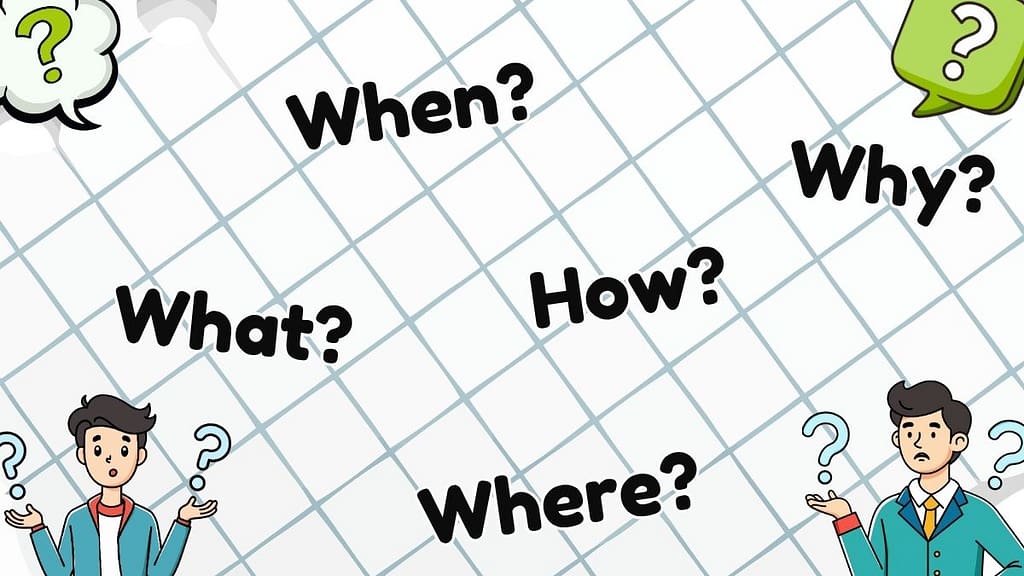
A Guide for ESL Learners on Who, What, Where, When, Why, and How (WH-Questions)
Learning a new language can be an exciting journey, and as an ESL (English as a Second Language) student, you’ve probably encountered the foundation of conversation: WH- questions. These essential question words—Who, What, Where, When, Why, and How—serve as keys to unlocking a wealth of information. However, knowing when to use each one and grasping their nuances can pose a challenge. This detailed guide will empower you with the knowledge and confidence to master WH- questions.
Imagine trying to engage in a conversation without the ability to ask for information; it would certainly be difficult, right? WH- questions are your essential tools for seeking understanding and participating in meaningful discussions. They are the fundamental components of communication, enabling you to inquire about people, objects, places, times, reasons, and methods. Mastering these questions will not only enhance your comprehension but also significantly elevate your conversational abilities.
Let’s explore each of these vital question words, understanding their roles and how they differ.
WHO – The Person Detective, pertains specifically to people. It helps us identify or inquire about individuals. Whether you’re curious about someone’s name, relationship, job, or identity, “Who” is your reliable investigator. “Who” is exclusively for people, not for objects, places, or abstract ideas. If your inquiry is about something other than a person, “Who” is not the appropriate choice.
Examples:
- Who is your best friend? (Inquiring about a specific individual)
- Who is the President of the United States? (Asking about a well-known figure)
- Who called me earlier? (Inquiring about an unidentified person)
WHAT – The Information Gatherer, is the most adaptable and commonly used WH- question word. Its purpose is to gather information about objects, actions, or concepts, making it the Swiss Army knife in your English question toolkit. Unlike “Who,” “What” is never used for people. While it can inquire about time (“What time?”), it is more general than “When.” It cannot ask about reasons (“Why”), manners (“How”), or locations (“Where”).
Examples:
- What is that object on the table? (Inquiring about an object)
- What are you doing? (Asking about an action)
- What time is it? (Asking for a specific time)
- What is your favorite color? (Inquiring about a preference)
WHERE – The Location Navigator, If you feel disoriented or need directions, “Where” is your trustworthy guide. We use “Where” to ask about specific places, positions, or directions. “Where” is exclusively concerned with locations and positions. It should not be used to ask about people, objects, time, or reasons.
Examples:
- Where is the nearest grocery store? (Inquiring about a location)
- Where do you live? (Asking about residence)
- Where did you put my keys? (Inquiring about a specific place)
WHEN – The Timekeeper, keeping track of time is vital, and “When” is your ultimate guide for this. This question word is utilized to ask about a specific time, duration, or occurrence of an event. “When” is solely related to time. While “What time?” is more precise (“What time is the class?”), “When” is broader (“When is the class?”). Neither can replace location inquiries (“Where”) or reasons (“Why”).
Examples:
- When does the movie start? (Asking for a specific time)
- When is your birthday? (Inquiring about an annual date)
- When did you graduate? (Asking about a past event)
WHY – The Curiosity Seeker, have you ever pondered the reasoning behind something? “Why” is your tool for curiosity. We use “Why” to ask for reasons, explanations, or purposes behind actions or situations. “Why” focuses exclusively on reasons and causes. It should not be used to inquire about people, objects, locations, or time.
Examples:
- Why are you studying English? (Inquiring about a reason)
- Why did you leave the party early? (Asking for an explanation)
- Why is the sky blue? (Seeking a scientific explanation)
HOW – The Manner and Method Explorer, sometimes, you may need to know how something is accomplished or its quality. “How” serves as your explorer for manner and methods. We use “How” to ask about the way actions are performed, the condition of something, or the extent of something. “How” is distinct as it often combines with other words to create specific question types (e.g., How often, How much, How long, How far). Its main function is to ask about manner, condition, or degree, differentiating it from other WH- questions.
Examples:
- How do you make lasagna? (Inquiring about a process)
- How are you feeling today? (Asking about a state)
- How long is the class? (Inquiring about duration)
- How much is this jacket? (Asking about cost)
Now that you grasp the essential differences between WH- questions, it’s time to put that knowledge into practice! These engaging activities are designed for ESL classrooms or self-study:
The WH- Question Hunt (Interactive for Classroom), in this activity, the students are divided into teams and will race to identify the appropriate WH-question for each statement. This game encourages the learners to actively engage with the lesson, aiming to promote their active listening and also their critical thinking. At the same time, this measures the understanding of the proper use of each WH-question by identifying where each WH-question corresponds.
The Interview Challenge (Great for Speaking Practice), for this activity, the students work in pairs to ask each other as many WH-questions as they can. Through this activity, the learners are given an opportunity to apply their knowledge. The interview activity encourages them to craft their own sentences that contain WH-questions. Consequently, this also targets both their fluency and their confidence in using their own sentences in daily / real-life conversations. At the same time, this activity can also help them build meaningful friendships with classmates.
The WH- Question Dice Game (Engaging and Adaptable), in this activity the students roll a dice for the WH-question and the topic that they’ll produce a question with and for. This reinforces their critical thinking and their mastery of the lesson since it is spontaneous.
Picture Description and WH- Inquiries (Visual and Descriptive), for the fourth activity, the students are shown a picture. They will observe the picture and generate WH-questions. This targets the learners ability to apply the lesson to situations and also enhances their descriptive language and observational skills.
The “Who, What, Where, When” Train (Collaborative Storytelling), this activity allows the learners to “drive” their own learning. Each student is given a piece of paper wherein they’ll write a simple phrase answering the first WH-question. They exchange papers with one another, adding words/elements that answer the succeeding WH-questions.
Even with a solid understanding of definitions, certain common pitfalls arise. Here are some key challenges and tips to navigate them:
- Confusing Who vs. What (People vs. Things)
This is the most common mistake. Remember, “Who” is strictly for individuals, while “What” refers to objects, events, and abstract concepts.
Incorrect: What is your teacher? (The teacher is a person)
Correct: Who is your teacher?
Incorrect: Who is that car? (A car is a thing)
Correct: What kind of car is that? / Whose car is that?
- Mixing Up Where vs. When (Location vs. Time)
While related, location and time represent distinct pieces of information.
Incorrect: When did you meet your friends yesterday? (Asking for time)
Correct: Where did you meet your friends yesterday? (If inquiring about location)
Incorrect: Where did the class start? (Asking for location)
Correct: When did the class start? (If asking about time)
Using “How” Instead of “What” for Certain Questions
ESL learners often use “How” where native speakers prefer “What.”
Incorrect: How do you call that?
Correct: What do you call that?
Incorrect: How did the weather look?
Correct: What was the weather like? (If asking for a description)
Becoming proficient with WH- questions is a crucial milestone on your ESL journey. It transforms you from a passive recipient of information into an active participant in communication. Remember, these question words are powerful tools that unlock understanding and connect you to the English-speaking world. Consistent practice, engagement with interactive activities, and embracing mistakes as part of the learning process will enable you to ask and answer WH- questions with confidence and ease. Best of luck, and keep those questions coming!
Leave a Reply